

Federalists Believed A Workable Government
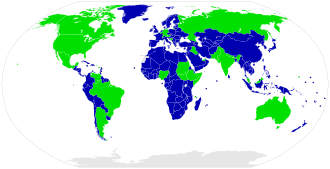
Federalism is a mixed or chemical compound mode of government that combines a general government (the central or "federal" government) with regional governments (provincial, state, cantonal, territorial, or other sub-unit governments) in a single political system, dividing the powers between the two. Federalism in the modern era was first adopted in the unions of states during the Onetime Swiss Confederacy.[one]
Federalism differs from confederalism, in which the general level of authorities is subordinate to the regional level, and from devolution inside a unitary state, in which the regional level of government is subordinate to the full general level.[2] It represents the primal form in the pathway of regional integration or separation, bounded on the less integrated side by confederalism and on the more integrated side past devolution within a unitary state.[3] [iv]
Examples of a federation or federal province or country include Argentina, Australia, Belgium, Bosnia & Herzegovina, Brazil, Republic of iraq, Canada, Germany, UAE, Mexico, India, Malaysia, Nepal, Nigeria, Pakistan, Russian federation, Switzerland, and United States. Some characterize the European union as the pioneering example of federalism in a multi-country setting, in a concept termed the "federal union of states".[five]
Overview [edit]

The pathway of regional integration or separation
Etymology [edit]
The terms "federalism" and "confederalism" share a root in the Latin word foedus, pregnant "treaty, pact or covenant". Their common early pregnant until the late eighteenth century was a uncomplicated league or inter-governmental relationship among sovereign states based on a treaty. They were therefore initially synonyms. It was in this sense that James Madison in Federalist No.39 had referred to the new U.s. Constitution as "neither a national nor a federal Constitution, merely a composition of both" (i.east. every bit constituting neither a single big unitary state nor a league/confederation amongst several modest states, but a hybrid of the ii).[6] In the course of the nineteenth century United States, the meaning of federalism would come to shift, strengthening to refer uniquely to the novel compound political form established at the Philadelphia Convention, while the meaning of confederalism would remain at a league of states.[vii]
Origin [edit]
In the narrow sense, federalism refers to the manner in which the body politic of a state is organized internally, and this is the meaning most oft used in modern times. Political scientists, however, utilize it in a much broader sense, referring instead to a "multi-layer or pluralistic concept of social and political life."[8]
The first forms of federalism took place in ancient times, in the course of alliances between states. Some examples from the seventh to 2d century B.C. were the Archaic League, the Aetolic League, the Peloponnesian League, and the Delian League. An early progenitor of federalism was the Achaean League in Hellenistic Greece. Unlike the Greek city states of Classical Greece, each of which insisted on keeping its consummate independence, changing weather condition in the Hellenistic period drove many city states to band together even at the cost of losing part of their sovereignty. Subsequent unions of states included the first and second Swiss Confederations (1291–1798 and 1815–48), the United Provinces of the netherlands (1579–1795), the German Bund (1815–66), the start American union known as the Confederation of the Usa (1781–89), and second American marriage formed every bit the United States of America (1789–1865).[9]
Political theory [edit]
Modernistic federalism is a political system based upon autonomous rules and institutions in which the power to govern is shared betwixt national and provincial/state governments. The term federalist describes several political beliefs around the world depending on context. Since the term federalization also describes distinctive political processes, its utilise as well depends on the context.[10]
In political theory, two main types of federalization are recognized:
- integrative,[eleven] or aggregative federalization,[12] designating various processes like: integration of non-federated political subjects past creating a new federation, accession of non-federated subjects into an existing federation, or transformation of a confederation into a federation
- devolutive,[11] or dis-aggregative federalization:[xiii] transformation of a unitary land into a federation
Reasons for adoption [edit]
According to Daniel Ziblatt, there are four competing theoretical explanations in the bookish literature for the adoption of federal systems:
- Ideational theories, which hold that a greater ideological commitment to decentralist ideas in society makes federalism more likely to be adopted.
- Cultural-historical theories, which agree that federal institutions are more likely to be adopted in societies with culturally or ethnically fragmented populations.
- "Social contract" theories, which agree that federalism emerges equally a deal between a center and a periphery where the centre is not powerful enough to dominate the periphery and the periphery is not powerful plenty to secede from the centre.
- "Infrastructural power" theories, which hold that federalism is likely to emerge when the subunits of a potential federation already take highly developed infrastructures (due east.g. they are already constitutional, parliamentary, and administratively modernized states).[14]
Immanuel Kant noted that "the trouble of setting up a state tin can be solved even past a nation of devils" so long as they possess an advisable constitution which pits opposing factions against each other with a organization of checks and balances. In detail individual states required a federation every bit a safeguard confronting the possibility of state of war.[15]
Proponents for federal systems have historically argued that the power-sharing inherent in federal systems reduces both domestic security threats and foreign threats. Federalism allows states to be large and various, mitigating the risk of a tyrannical government through centralization of powers.[16] [17]
Examples [edit]
Many countries accept implemented federal systems of regime with varying degree of central and regional sovereignty. The federal government of these countries tin can be divided into minimalistic federations, consisting of only two sub-federal units or multi-regional, those that consist of three to dozens of regional governments. They tin besides exist grouped based on their body polity type, such as emirate, provincial, republican or state federal systems. Another way to study federated countries is past categorizing them into those whose unabridged territory is federated as opposed to only part of its territory comprising the federal portion of the country. Some federal systems are national systems while others, like the European Matrimony are supra national.
In full general, 2 extremes of federalism can exist distinguished: at one extreme, the strong federal state is almost completely unitary, with few powers reserved for local governments; while at the other extreme, the national government may be a federal state in name only, being a confederation in actuality. Federalism may comprehend every bit few as two or iii internal divisions, as is the case in Belgium or Bosnia and Herzegovina.
The governments of Argentina, Commonwealth of australia, Brazil, India, and Mexico, amid others, are also organized along federalist principles.
In Canada, federalism typically implies opposition to sovereigntist movements (most usually Quebec separatism).[xviii] In 1999, the Government of Canada established the Forum of Federations as an international network for exchange of best practices among federal and federalizing countries. Headquartered in Ottawa, the Forum of Federations partner governments include Australia, Brazil, Ethiopia, Germany, Bharat, United mexican states, Nigeria, Pakistan and Switzerland.
Europe vs. the United States [edit]
In Europe, "federalist" is sometimes used to describe those who favor a mutual federal regime, with distributed power at regional, national and supranational levels. Most European federalists want this evolution to continue within the European Union.[19] Although there are medieval and early modern examples of European states which used confederal and federal systems, contemporary European federalism originated in post-war Europe; one of the more than important initiatives was Winston Churchill'due south spoken language in Zürich in 1946.[twenty]
In the United States, federalism originally referred to belief in a stronger central authorities. When the U.South. Constitution was being drafted, the Federalist Party supported a stronger central government, while "Anti-Federalists" wanted a weaker central authorities. This is very unlike from the mod usage of "federalism" in Europe and the The states. The distinction stems from the fact that "federalism" is situated in the middle of the political spectrum between a confederacy and a unitary land. The U.S. Constitution was written every bit a replacement for the Articles of Confederation, nether which the United States was a loose confederation with a weak cardinal government.
In contrast, Europe has a greater history of unitary states than North America, thus European "federalism" argues for a weaker central government, relative to a unitary state. The modernistic American usage of the discussion is much closer to the European sense. As the power of the U.S. federal government has increased, some people[ who? ] take perceived a much more than unitary state than they believe the Founding Fathers intended. Most people politically advocating "federalism" in the United States argue in favor of limiting the powers of the federal government, peculiarly the judiciary (meet Federalist Society, New Federalism).
The contemporary concept of federalism came about with the creation of an entirely new organisation of government that provided for democratic representation at two governing levels simultaneously, which was implemented in the US Constitution.[21] [22] In the United States implementation of federalism, a bicameral full general authorities, consisting of a chamber of pop representation proportional to population (the House of Representatives), and a chamber of equal Country-based representation consisting of two delegates per State (the Senate), was overlaid upon the pre-existing regional governments of the 13 independent States. With each level of government allocated a defined sphere of powers, under a written constitution and the rule of law (that is, subject to the independent third-party arbitration of a supreme court in competence disputes), the two levels were thus brought into a coordinate relationship[ further explanation needed ] for the first fourth dimension.
In 1946, Kenneth Wheare observed that the two levels of government in the US were "co-every bit supreme".[23] [ full citation needed ] In this, he echoed the perspective of American founding father James Madison who saw the several States every bit forming "singled-out and independent portions of the supremacy"[24] in relation to the general government.
Constitutional structure [edit]
Partitioning of powers [edit]
In a federation, the partition of ability between federal and regional governments is usually outlined in the constitution. Almost every country allows some degree of regional self-government, just in federations the right to self-regime of the component states is constitutionally entrenched. Component states often also possess their ain constitutions which they may amend as they see fit, although in the event of conflict the federal constitution usually takes precedence.
In almost all federations the key regime enjoys the powers of foreign policy and national defense as exclusive federal powers. Were this not the example a federation would not exist a single sovereign country, per the UN definition. Notably, united states of america of Germany retain the correct to human activity on their ain behalf at an international level, a condition originally granted in exchange for the Kingdom of Bavaria's understanding to join the German language Empire in 1871. Across this the precise division of power from one nation to some other. The constitutions of Germany and the United States provide that all powers not specifically granted to the federal authorities are retained by the states. The Constitution of some countries similar Canada and India, state that powers non explicitly granted to the provincial governments are retained by the federal government. Much like the US system, the Australian Constitution allocates to the Federal authorities (the Commonwealth of Australia) the power to brand laws about sure specified matters which were considered likewise difficult for usa to manage, and then that usa retain all other areas of responsibility. Under the sectionalization of powers of the European Marriage in the Lisbon Treaty, powers which are not either exclusively of Union competence or shared between the Union and the Member States as concurrent powers are retained by the constituent States.

Satiric delineation of tardily 19th-century political tensions in Spain
Where every component land of a federation possesses the same powers, we are said to discover 'symmetric federalism'. Asymmetric federalism exists where states are granted different powers, or some possess greater autonomy than others exercise. This is often done in recognition of the being of a distinct culture in a detail region or regions. In Spain, the Basques and Catalans, as well equally the Galicians, spearheaded a historic movement to have their national specificity recognized, crystallizing in the "historical communities" such every bit Navarre, Galicia, Catalonia, and the Basque Country. They have more powers than the afterward expanded system for other Spanish regions, or the Espana of the autonomous communities (chosen also the "java for everyone" arrangement), partly to deal with their separate identity and to appease peripheral nationalist leanings, partly out of respect to specific rights they had held earlier in history. However, strictly speaking Spain is not a federation, but a system of disproportionate devolved regime inside a unitary country.
It is mutual that during the historical evolution of a federation at that place is a gradual movement of power from the component states to the centre, as the federal government acquires additional powers, sometimes to deal with unforeseen circumstances. The acquisition of new powers by a federal government may occur through formal constitutional amendment or simply through a broadening of the interpretation of a regime'southward existing constitutional powers given by the courts.
Normally, a federation is formed at two levels: the primal regime and the regions (states, provinces, territories), and little to nothing is said about 2d or 3rd level administrative political entities. Brazil is an exception, because the 1988 Constitution included the municipalities as autonomous political entities making the federation tripartite, encompassing the Spousal relationship, usa, and the municipalities. Each state is divided into municipalities (municípios) with their own legislative council (câmara de vereadores) and a mayor (prefeito), which are partly autonomous from both Federal and State Government. Each municipality has a "trivial constitution", called "organic law" (lei orgânica). Mexico is an intermediate case, in that municipalities are granted full-autonomy by the federal constitution and their existence equally autonomous entities (municipio libre, "free municipality") is established by the federal government and cannot be revoked by the states' constitutions. Moreover, the federal constitution determines which powers and competencies belong exclusively to the municipalities and non to the constituent states. However, municipalities exercise not have an elected legislative assembly.
Federations often employ the paradox of being a union of states, while still existence states (or having aspects of statehood) in themselves. For example, James Madison (writer of the US Constitution) wrote in Federalist Paper No. 39 that the U.s.a. Constitution "is in strictness neither a national nor a federal constitution; but a composition of both. In its foundation, information technology is federal, not national; in the sources from which the ordinary powers of the Regime are fatigued, it is partly federal, and partly national..." This stems from the fact that states in the Usa maintain all sovereignty that they practice non yield to the federation by their own consent. This was reaffirmed by the Tenth Amendment to the Us Constitution, which reserves all powers and rights that are not delegated to the Federal Regime as left to usa and to the people.
Bicameralism [edit]
The structures of most federal governments incorporate mechanisms to protect the rights of component states. One method, known equally 'intrastate federalism', is to directly represent the governments of component states in federal political institutions. Where a federation has a bicameral legislature the upper business firm is oft used to correspond the component states while the lower house represents the people of the nation as a whole. A federal upper firm may be based on a special scheme of apportionment, equally is the example in the senates of the Usa and Australia, where each country is represented by an equal number of senators irrespective of the size of its population.
Alternatively, or in addition to this exercise, the members of an upper business firm may be indirectly elected by the regime or legislature of the component states, as occurred in the United States prior to 1913, or be actual members or delegates of the state governments, as, for example, is the case in the German language Bundesrat and in the Quango of the European Union. The lower house of a federal legislature is unremarkably straight elected, with circulation in proportion to population, although states may sometimes still be guaranteed a certain minimum number of seats.
Intergovernmental relations [edit]
In Canada, the provincial governments represent regional interests and negotiate directly with the central authorities. A First Ministers conference of the prime number minister and the provincial premiers is the de facto highest political forum in the land, although information technology is not mentioned in the constitution.
Constitutional change [edit]
Federations often take special procedures for amendment of the federal constitution. Also every bit reflecting the federal structure of the state this may guarantee that the self-governing condition of the component states cannot be abolished without their consent. An amendment to the constitution of the Us must be ratified by three-quarters of either the state legislatures, or of constitutional conventions specially elected in each of the states, before it can come into effect. In referendums to amend the constitutions of Commonwealth of australia and Switzerland information technology is required that a proposal be endorsed not merely by an overall majority of the electorate in the nation as a whole, only also by divide majorities in each of a majority of the states or cantons. In Australia, this latter requirement is known as a double majority.
Some federal constitutions also provide that certain constitutional amendments cannot occur without the unanimous consent of all states or of a particular state. The U.s.a. constitution provides that no state may be deprived of equal representation in the senate without its consent. In Commonwealth of australia, if a proposed amendment will specifically bear upon one or more states, so it must be endorsed in the plebiscite held in each of those states. Any subpoena to the Canadian constitution that would alter the function of the monarchy would require unanimous consent of the provinces. The German language Basic Law provides that no amendment is admissible at all that would abolish the federal system.
Other technical terms [edit]
- Fiscal federalism – the relative financial positions and the financial relations between the levels of government in a federal system.
- Formal federalism (or 'ramble federalism') – the delineation of powers is specified in a written constitution, which may or may non correspond to the actual operation of the system in practice.
- Executive federalism refers in the English-speaking tradition to the intergovernmental relationships between the executive branches of the levels of government in a federal system and in the continental European tradition to the fashion elective units 'execute' or administer laws made centrally.
- Gleichschaltung – the conversion from a federal governance to either a completely unitary or more unitary one, the term was borrowed from the German language for conversion from alternate to direct current.[25] During the Nazi era the traditional German states were mostly left intact in the formal sense, but their constitutional rights and sovereignty were eroded and ultimately ended and replaced with the Gau system. Gleichschaltung likewise has a broader sense referring to political consolidation in general.
- defederalize – to remove from federal government, such as taking a responsibleness from a national level government and giving it to states or provinces
In relation to conflict [edit]
Information technology has been argued that federalism and other forms of territorial autonomy are a useful way to structure political systems in order to forestall violence among different groups within countries because information technology allows sure groups to legislate at the subnational level.[26] Some scholars have suggested, all the same, that federalism can divide countries and result in state collapse because it creates proto-states.[27] Yet others accept shown that federalism is only divisive when it lacks mechanisms that encourage political parties to compete across regional boundaries.[28]
Federalism is sometimes viewed in the context of international negotiation as "the all-time system for integrating various nations, ethnic groups, or combatant parties, all of whom may take cause to fear control past an overly powerful centre."[29] However, those skeptical of federal prescriptions sometimes believe that increased regional autonomy can lead to secession or dissolution of the nation.[29] In Syria, for example, federalization proposals have failed in office considering "Syrians fearfulness that these borders could turn out to be the same as the ones that the fighting parties have currently carved out."[29]
Run across also [edit]
- Republic – Term for a political community founded for the common expert
- Consociationalism – Political power sharing among cultural groups
- Cooperative federalism – Flexible government where state and national level cooperate
- Autonomous World Federalists – Organization
- Feudalism – Combination of legal and military machine customs and form of government in medieval Europe
- Neo-feudalism – Theoretic rebirth of antique governance
- Federal republicanism
- Federal Union
- Forum of Federations
- Layer cake federalism
- Non-governmental federation – Federations which are not states or national governments
- Pillarisation
- States' rights – Political powers reserved for US states
- Spousal relationship of Utrecht – 1579 treaty unifying the northern Netherlands provinces
- Globe Federalist Movement – Move advocating earth institutions
Notes and references [edit]
- ^ Forsyth 1981, p. eighteen.
- ^ Wheare 1946, pp. 31–22.
- ^ Meet diagram below.
- ^ Diamond, Martin (1961) "The Federalist's View of Federalism", in Benson, George (ed.) Essays in Federalism, Constitute for Studies in Federalism, Claremont, p. 22. Downs, William (2011) "Comparative Federalism, Confederalism, Unitary Systems", in Ishiyama, John and Breuning, Marijke (eds) 20-beginning Century Political Science: A Reference Handbook, Sage, Los Angeles, Vol. I, pp. 168–169. Hueglin, Thomas and Fenna, Alan (2006) Comparative Federalism: A Systematic Inquiry, Broadview, Peterborough, p. 31.
- ^ Come across Law, John (2013), p. 104. http://www.on-federalism.eu/attachments/169_download.pdf
This author identifies ii distinct federal forms, where before merely ane was known, based upon whether sovereignty (conceived in its core meaning of ultimate authorisation) resides in the whole (in one people) or in the parts (in many peoples). This is determined by the absenteeism or presence of a unilateral right of secession for the parts. The structures are termed, respectively, the federal state (or federation) and the federal spousal relationship of states (or federal union). - ^ Madison, James, Hamilton, Alexander and Jay, John (1987) The Federalist Papers, Penguin, Harmondsworth, p. 259.
- ^ Law, John (2012) "Sense on Federalism", in Political Quarterly, Vol. 83, No. three, p. 544.
- ^ Bulmer, Elliot. "Federalism" (PDF). International IDEA Constitution-Building Primer 12: 12.
- ^ Forsyth 1981, pp. 18, 25, 30, 43, 53, 60.
- ^ Broschek 2016, p. 23–50.
- ^ a b Gerven 2005, p. 35, 392.
- ^ Broschek 2016, pp. 27–28, 39.
- ^ Broschek 2016, pp. 27–28, 39–41, 44.
- ^ Ziblatt, Daniel (2008). Structuring the State: The Formation of Italy and Germany and the Puzzle of Federalism. Princeton Academy Press. ISBN9780691136493.
- ^ Reiss, H.S. (2013). Kant: Political Writings. ISBN9781107268364.
- ^ Deudney, Daniel H. (2007). Bounding Power: Republican Security Theory from the Polis to the Global Village. Princeton University Press. ISBN978-1-4008-3727-iv.
- ^ Deudney, Daniel (2004). "Publius Earlier Kant: Federal-Republican Security and Democratic Peace". European Journal of International Relations. 10 (iii): 315–356. doi:10.1177/1354066104045540. ISSN 1354-0661. S2CID 143608840.
- ^ "CBC on Federalism and Separatism".
- ^ "70_Years_of_Campaigns_for_a_United_and_Federal_Europe" (PDF). www.federalists.eu. Union of European Federalists. 2016.
- ^ "The Churchill Society London. Churchill'due south Speeches". www.churchill-club-london.org.britain.
- ^ Law, John (2012) "Sense on Federalism", in Political Quarterly, Vol. 83, No. three, pp. 543–544.
- ^ Wheare 1946, p. eleven.
- ^ Wheare 1946, pp. 10–xv.
- ^ Madison, James, Hamilton, Alexander and Jay, John (1987) The Federalist Papers, Penguin, Harmondsworth, p. 258.
- ^ Koonz, Claudia (2003). The Nazi Censor . Cambridge, MA: Belknap Press of Harvard University Printing. p. 72. ISBN978-0-674-01172-iv.
- ^ Lijphart, Arend (1977). Republic in Plural Societies: A Comparative Exploration. New Oasis, CT: Yale Academy Press.
- ^ Unhurt, Henry E. (2004). "Divided We Stand: Institutional Sources of Ethnofederal State Survival and Collapse". World Politics. 56 (2): 165–193. doi:10.1353/wp.2004.0011. ISSN 1086-3338. S2CID 155052031.
- ^ Dawn Brancati. 2009. Peace by Design: Managing Intrastate Disharmonize through Decentralization. Oxford: Oxford Upward.
- ^ a b c Michael Meyer-Resende, Why Talk of Federalism Won't Help Peace in Syria, Strange Policy (March 18, 2017).
Sources [edit]
- Bednar, Jenna (2011). "The Political Science of Federalism". Almanac Review of Police force and Social Science. seven: 269–288. doi:10.1146/annurev-lawsocsci-102510-105522.
- Broschek, Jorg (2016). "Federalism in Europe, America and Africa: A Comparative Assay". Federalism and Decentralization: Perceptions for Political and Institutional Reforms (PDF). Singapore: Konrad Adenauer Stiftung. pp. 23–50.
- Forsyth, Murray (1981). Unions of States: The Theory and Do of Confederation. Leicester University Printing. OCLC 1170233780.
- Gerven, Walter van (2005). The European Spousal relationship: A Polity of States and Peoples. Stanford: Stanford University Press. ISBN9780804750646.
- Wheare, Kenneth (1946). Federal Government. London: Oxford Academy Printing.
External links [edit]

Wait up federalism in Wiktionary, the gratis dictionary.

Wikimedia Commons has media related to Federalism.
- P.-J. Proudhon, The Principle of Federation, 1863.

Federalists Believed A Workable Government,
Source: https://en.wikipedia.org/wiki/Federalism
Posted by: coxgromer.blogspot.com
0 Response to "Federalists Believed A Workable Government"
Post a Comment