

Columbus Salame Secchi How To Eat
What is the White Powdery Stuff on My Salami?
October eight, 2020
It'due south mold. Yup, you read that right. The powdery stuff on your salami is mold, merely it'southward the good kind of mold, and it's completely edible. We go this question a lot, and it's usually with a frantic tone because, well, bad mold can be harmful. Hither I'm going to break down what kind of mold is on our salami and why there is mold on our salami. Then let's clear up the confusion!
What is the mold on my salami?
When y'all open up one of our salamis from the packaging, you will immediately discover a white mold coated outside the salami. Don't worry; information technology'due south supposed to exist in that location! It is a penicillin-based mold similar to the white mold you lot will detect on a fine cheese like a French Brie or Camembert. It's a natural part of the fermentation process of producing artisanal salumi, and the salami mold has its ain flavour and flora.

Why is there mold on my salami?
Simply put, the mold protects the salami from bad mold and bacteria.
We stuff our salami into all-natural casings , and as part of the process, we inoculate a mold solution onto the casings by soaking them earlier stuffing them. Once the casings are stuffed with salami, they are put into our climate-controlled fermentation rooms set at 100% humidity and 75 degrees. Obviously, that'southward not the ideal temperature to store meat, just it is the perfect climate to ferment our salumi.

Now that the salami is in our fermentation rooms, the fermentation process begins and is an integral part of making salami. During fermentation, the lactic acid starter culture feeds on sugars that are part of our recipes. The sugar is consumed by the starter civilization, which lowers the meat's pH to a safety level. This procedure is critical and creates the unique, tangy season that is nowadays in our salami.
(Fiddling fact; nosotros're required to list the sugar in our recipes on the product ingredient list, but the sugars are non nowadays in the last product. The starter cultures consume all the sugar. Nosotros can't telephone call the product "carbohydrate-complimentary", but there are indeed no residual sugars in our finished salami.)
As the salami pH reaches a level below 5.0, the fermentation process kills any harmful bacteria present in the raw pork nosotros employ. Plus, every bit the salami ferments, all of that beautiful white penicillin-based mold blooms and starts to grade a luscious white coat on the salami'due south outside.

After fermentation, the salami is moved to our climate-controlled drying rooms, where the mold continues to blossom throughout the drying process. This is where the penicillin-based mold actually starts doing its job. The mold protects the salami from any harmful bacteria getting within the product. It serves an essential purpose and is office of what we phone call the "terroir" of our product, giving our salami a unique flavor and flora, similar to fine wine.

Is the mold on my salami dangerous to eat?
The mold is not unsafe to consume. Of form, y'all can easily remove the casing if y'all prefer non to eat the mold. The mold does take a unique flavor and flora that it adds to our products.
Personally, I practise not consume the casing or the mold on our salami, as that is my preference. I feel like what is within the casing is what I desire to taste, but I know enough of people who enjoy eating the exterior. So, the choice is upwards to you lot but know that the salami mold isn't going to injure yous.

Why does the mold look dissimilar than last time?
The mold that we employ to produce our salami is 100% natural and tin can bloom into unlike colors throughout the drying process. I have seen hues of blue, greenish, grey, and yellow, all of which are entirely natural and safe.

Once again, the mold is present to protect the production from other competing mold or bacteria growth during the drying process. This good mold does indeed protect the salami from whatsoever potentially harmful molds present in the environs. And, it helps our products dry slowly and evenly to produce a genuinely supple finished product.
Does the mold on salami crave special handling?
You lot practice non demand to worry about touching or removing too much mold when you're handling the salami. Feel gratuitous to get a proficient grip on the salami when cutting it. The mold will not hurt you lot if you touch your face or put your finger in your mouth afterward holding the salami.
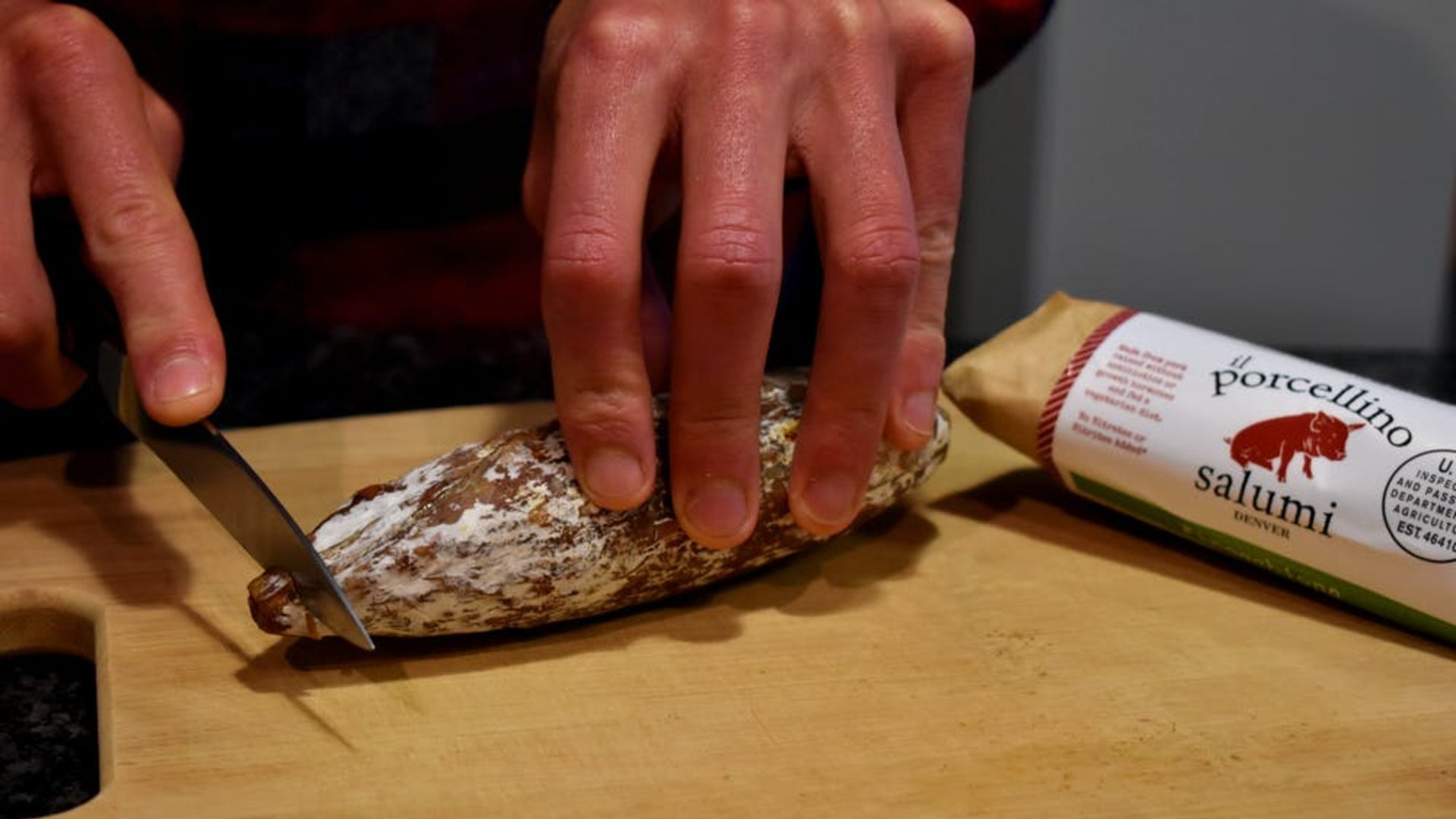
As part of the home storage procedure, I recommend storing your il porcellino salumi in one of the crisper drawers in your refrigerator. Once you open up and cut the salami, rewrap the product in its newspaper packaging and shop information technology inside an unsealed ziplock bag. Keeping the salami this mode allows the product to keep to "breathe." The salami and the mold itself do indeed require oxygen to go along to grow. If the airflow is cut off, then the mold begins to die and will create an unpleasant aroma and flavor. Our salami has a shelf life of nine months when stored correctly in your domicile refrigerator.
Now you can cease worrying and just enjoy the salami.

Source: https://www.ilporcellinodenver.com/blogs/bills-blog/salami-mold
0 Response to "Columbus Salame Secchi How To Eat"
Post a Comment